Reflections on Las Vegas was a piece I wrote with my tongue so far in my cheek I could have punched a hole right through it. Yet, like anything I decide to write about, there is still rich subtextual commentary underneath here, and the situation itself was not an enjoyable one at all despite my playful tone. I hope the mischievous mood of the piece remains central for readers despite the dismal circumstances I went through. This approach felt appropriate considering Vegas does the same thing: sugarcoats the fuck out of otherwise poor decisions.
Since I have been tall enough to overfill a standard coach airline seat (not much of an accomplishment in the economy of the twenty-first century), I have strongly disliked flying. I do not, however, hate flying enough never to do it, so as to miss out on the delight of traveling or seeing close friends or extended family. In the case of a recent trip to see a friend in St. Louis, I also did not get the privilege of missing the debacle mediated by the slimes at the Frontier Airlines customer service department.
I had booked the trip on a strict budget, and was able to snag round-trip tickets for under a hundred dollars, and was, up until this point, a frequent flier of Frontier for their accessible rates. When I arrived at the airport and stood in the rather long line for such an early morning flight, I was informed that the computer system was down in some irreparable way, and that until it was remediated, nobody could be checked into their flights or have their luggage tagged. I was already on a tight timeline as is typical of my disorganized lifestyle, and quickly realized that the chances were great that I was to miss my flight.
I approached the nearest Frontier agent, and explained my dismal situation. Their sympathy was well meaning but quite hollow, and didn’t contain anything that could be construed as an apology, but they stated the facts in a blunt way I half appreciated: “The only thing we can do is put you on a flight with a six hour layover in Vegas.” In my carnivorous desperation I accepted the proposition and was on my way to the new flight which departed not too much later.
The trip through security was much more painless, and I must have encountered the only crew of TSA agents who hadn’t been jaded by the common human intellect, or dulled from the combat of herding glazed-over and uninitiated fliers. I tried in vain, as one does, to sleep on the plane.
* * *
There is a moment when you step out onto the jet bridge of a different location, following a grueling flight, that evokes Neil Armstrong’s first step on the moon. A rush of unfamiliarly humid air for a Denverite like me feels like stepping through a portal. This was not the case, immediately following my mistake-born flight to Las Vegas, Nevada. I kept waiting for a delayed smack from the foreign air as I walked through Harry Reid International Airport, but it never came; the air seemed to hang there and carried a scent like dry weeds and faded cigarette smoke. This was the scent that would grow stronger as I drifted closer to the center of the solar system of casinos not three miles from the airport. Just then, I received a text from the airline informing me that my connecting flight to St. Louis was cancelled. I quarreled with the ticketing desk, then walked away in defeat. I had been marooned in Vegas by Frontier, and humbled by the impossibility of a refund, a hotel room, or a recharter to another flight to St. Louis before the following day.
After biting the bullet on another plane ticket, this time on Southwest, I attempted to call an Uber, and had my wound salted by two cancellations before a glossy black Cadillac Escalade pulled up, with spinning rims and purple LED lights under-girding the skirts of the whale-sized vehicle. A short Uber ride took me from the airport to the outer rim of the Las Vegas Strip, where I could bide three and a half hours of my time before my new flight departed. My driver was a large man with a deep voice. He was adorned with a purple blazer, Cartier sunglasses, a gold chain, and a felt fedora. His name was Cleveland, and he called me “baby.” Clearly existing inside this man was the cartoonish spirit of Las Vegas I had constructed in my mind based on depictions in the media. As we drove, I gazed over the landscape of the clay-shingled houses filling the space outside the Las Vegas strip. They seemed to invariably guide my eyes to the skyline of The Strip and, to any viewer from the highway, held their position like soldiers in formation looking on at their commander. While the dry air was very much of the deserts of Nevada, the rest of the city seemed paradoxically lush, strikingly green and glittered with palm trees like some paradise off a California postcard. All of this belied the arid, sweltering heat that afflicts the city most months of the year besides the one in which I was there.
I arrived at the casino that supposedly had the cheapest decent diner inside, to find exactly what I would pay for; all nine dollars and eighty cents of it. The Casino could have been a Motel Six if it weren’t for the neon signs and weathered Sandals Resort advertisements plastered to the walls and bus stops and windows. I sat down to eat in the restaurant inside, windowless, but almost identical to a Denny’s or an Ihop in atmosphere. The bustling workers, and the smell of the food contained in the stucco, vaguely Southwestern themed diner reminded me that I was in culturally Southwest desert. While I ate, I savoured what I knew would be the last sense of humility in my environment before I took on the luxury and glitz of The Strip.
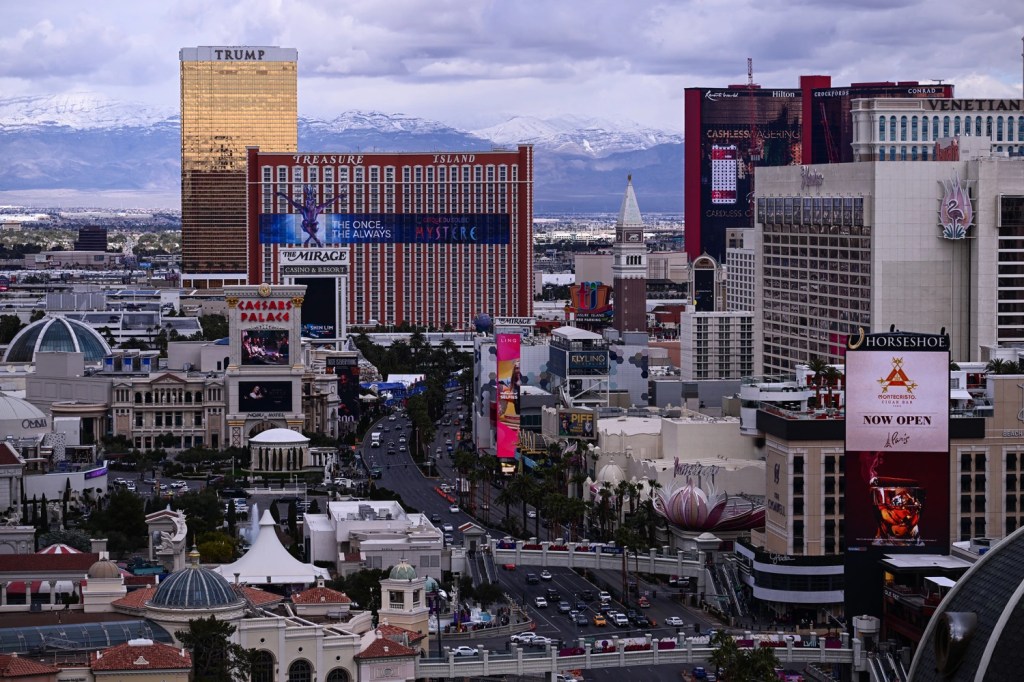
I continued my pilgrimage on foot. I had resolved to witness what I interpreted as the only significant thing about the entire state of Nevada, and didn’t count any memories from my short trip there spent mostly in the hotel room when I was twelve. After walking about ten blocks, the first large casino and hotel seemed to turn to me and present itself. I was welcomed into The Strip by an eclectic mix of neon, glass and water features. The experience of the first couple blocks felt like a blend of walking through a Warner Brothers film set, and a banking district in some major city. I followed the crowd on the sidewalk like a salmon in its school, meandering along with the current. Eventually the congested sidewalk opened up into a strand, walled up on all sides with casinos and restaurants. The smell of cigarettes was now a constant backdrop with interludes of pizza, grilled meat, and arbitrarily deep-fried confections. The Bellagio, Caesar’s Palace, and the Eiffel Tower all stood over me in a sort of grandeur which started to fade quickly into a feeling of entrapment. I looked down to ground myself in my overstimulation, only to find the concrete littered with escort business cards and pictures of naked women. I felt subtly nauseous, as though this place occupied a different frequency of existence in which humans were never meant to travel through. The presence of the Eiffel tower, A Greek Palace, and various parodies of neoclassical architecture beset gratuitously with fountains, made this place into a sort of supersized British Museum. Everything there was imported, from the water, to the tourists, to the culture. I had truly passed through a portal. My upheaval was set to the somber saxophone cover of “If You Could Read My Mind” by Gordon Lightfoot that the street performer was playing. I slowly and instinctively turned back the way I came, and feeling starved for morality by the pornography and vice and lights, I put five dollars in the performer’s jar.
There was something surreal about The Strip. Its manufactured allure was beyond even the circus, and it seemed to exist in utter defiance of natural order in every way. Many people there walked down the street in so much plastic and neon and makeup that they could have been an animatronic, or some kind of replicant from the dystopian world of Blade Runner. The Drive back from The Strip was a very different view. The clay shingled homes, the forlorn urban basketball courts, and the infrastructural bloat that typically fill a city were now the setting, peeping between these majestic skyscraping casinos. The domesticity of this vision lurking behind the fabrication of such decadent money-pits cheapened the attempts of these Casinos to isolate me any longer from the real world. My anxiety lessened. I asked my Uber driver what it’s like to live in Vegas, and realized before the sentence fully escaped my lips that he had been asked this before. He said “It’s fine. The people are mean.” I left him alone, and decided to daydream about what it would be like to grow up near what I had just witnessed. I felt the gravitational pull of The Strip weaken in my chest as I rode further and further away toward the airport.
Beneath Las Vegas, there is nothing. Even its name seems to evaporate under scrutiny. It passes as Spanish to all but native speakers who know that Vegas does not mean anything. Its progenitors claim it means “The Meadows” in Spanish, but any native speaker could tell you that meadow translates to “Prado” or “Pradera.” Even “Vega” denotes a grassy and green valley, the last thing anyone could have imagined when settling the wasteland by Death Valley. I prefer to imagine Las Vegas means “The Corporation,” because like any good corporation, it is markedly different within than it is outside. Up front it is glistening, beckoning, and behind, the workers unbutton their bellboy costumes and smoke cigarettes while they clean up vomit off the concrete. It is a liminal space filled up in its belly with the quiet desperation of battleaxe locals and eager tourists. Somewhere that exists between things, in the cracks. It is the last outpost before travelers reach the golden west coast, and the place where frugal airlines send people to serve their time before a connecting flight becomes available. It is for me, as it is for many, a River Styx, and I can certainly say I lost part of my soul there. My pilgrimage had been nothing like I expected, and everything. I remembered my best friend sympathetically deploying the name “Sin City” when I had explained why he would need to pick me up at the St. Louis airport so much later than expected. This city, in its essence, stood heavy and eternal like the Colossus of Rhodes; a geographic sin situated between temptation and forgiveness.
Las Vegas, strictly speaking, should not exist. There is nothing remotely rational, about taking an abhorrent amount of resources and relocating it to an otherwise uninhabitable place. The best explanation for what I had experienced dawned on me during my connecting flight to where I would have been the whole time, had it not been for the misfortune that comes along with ultra-low-cost plane tickets. As I was being force fed Christopher Nolan’s Oppenheimer by the seatback TV screen which wouldn’t turn off for some reason, I did a quick Google search to supplement my viewing —with some less dramatized history of nuclear testing and development. “The Nevada Test Site (NTS), now known as the Nevada National Security Site (NNSS), was a nuclear weapons test site located 65 miles north of Las Vegas where 928 nuclear tests were conducted between 1951 and 1992, including both atmospheric and underground tests,” according to Google’s top result. Las Vegas itself, I realized, is a different sort of test site. It is a place where people go to conduct self-destructive tests, to push the limits of their own capabilities for vice and pleasure; the true end-of-the-line for many debauchers seeking unearned prosperity. It is planted in the middle of a useless desert, because that is where such activities must take place; somewhat clandestine and far from governed society and suburban homes. What people do in Vegas is much quieter than an atomic blast, but no less destructive. Even a walk through the zooish landscape left my spirit irradiated. Whether Las Vegas as a concept is more or less ethical than the radioactive nuclear testing which took place concerningly close its north side, I still cannot decide.
 The Sanford Dispatch