Small moments spawning deep meaning as the goal of my creative writing was something I first got hooked on while writing this specific piece. The zoo is one of the most innocent places in society, associated with children and peanuts, yet I felt there was something more sinister underneath it conceptually by the end of my work on this. There was undoubtedly much to write about that people may not have considered regarding the absurdity of living beings being held for our amusement, and so I tried to code it all into the imagery here.
While on a break from college, I went to the Saint Louis Zoo with a close friend I was visiting, and saw the chimpanzee exhibit. I have never considered myself a staunch Darwinist, nor a fanatical humanizer of the animal kingdom, but there is something about the experience of looking into the eyes of a primate in particular, which is similar to the brief eye contact one has with a stranger in the department store; a gaze of vulnerable inquisition which celebrates your common humanity. For most of my life, however, I have been more accustomed to the common gawker given my taller stature of almost 6’8”.
The St. Louis zoo holds a special place among municipally sponsored zoos in that admission is free. As I floated down the brick walkway, I did not see any advertisements encouraging me to give back, nor any placards worshipping wealthy donors who insist on including their middle initial in address. The experience did not demand a thing in return, and for any of the adult patrons walking behind the flocks of children skipping from exhibit to exhibit, was rather mundane. This menagerie of animals, uprooted and imported from as far as the Northern Arctic, or Africa, to a midwestern American city, was indeed only mildly amusing to the adults who lumbered through —perhaps not enough to justify even a five dollar entry fee lest they ever change their free-admission policy.
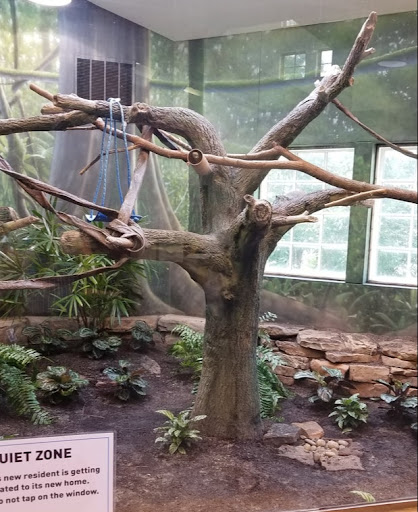
As I walked through the crested entrance to the primate exhibit, the path snaked back and forth guiding my focus from sign to sign which labeled each monkey, gorilla, or chimp with its corresponding given name. As we entered the shaded vestibule just before the exhibit, my friend brought up that he had read about how dangerous chimpanzees are in the wild. Male chimps have often killed and eaten infants of other tribes, and the term “going ape” is based on a pervasive truth in primate behavior. I wondered what abject aggression and virility could drive an animal to infant cannibalism; what indomitable force of nature or genetics could churn out such senseless violence. When I approached the enclosure, it was one of the few I had seen with a reinforced glass division from floor to ceiling. Looking through the thick glass, the exhibit appeared empty at first, but after some scrutiny, I narrowed in on only one chimpanzee that was to be subjected to prying eyes that day. He had found a nook toward the bottom rear of the exhibit, below the climbing limbs and water features and countless toys, and remained rather still there, with his face mostly turned inward toward what looked like a metal door. His coat seemed thin, and in several places along the spine, the pattern of hair resembled that of an aged, balding man. Periodically he would, with some visible labor, raise his hands to hide his face, before going back to playing with the wood chips of the enclosure floor. Always he remained in the one part of the terrarium that forced me to crane my neck to see him.
As most crowds in public zoos and aquariums do, many children and some adults pressed themselves close to the glass to get a more invasive look. As my neck had begun to get sore, I became acutely aware of my own strain to continue my fixed gaze on him, and looked away when he again obscured his face. I felt strange suddenly, like some right had been violated. I intuited that I had participated in a sort of voyeurism for the cost of merely walking from the parking lot.
I spoke with a zookeeper who was exiting a nearby gorilla enclosure and inquired about how the lifestyle of the chimp compares to that of the wild, and he proudly exclaimed that his diet and living conditions far exceeded anything they had experienced, or would have experienced, in their country of origin. After noticing my persisting puzzled fixation on this chimp and his tinkering with the woodchips, he added: “He likes his privacy!” I reflexively reaffirmed “me too.” For the remainder of my time in the zoo, I was not sure why I felt so odd about my gazing at the chimpanzee. I was more attuned to the gazes of the zoo-goers than to any of the animals themselves.
As I was departing the gift shop, a group of school children stared unblinkingly at me as I walked past, scanning from my shoes to my hair, both of which added a few inches to my already freakishly long build. I wanted to cover my face.
 The Sanford Dispatch